They returned to college in their 30s as moms and made the most of their Bruin adventure

The transformational social change leader urged audience members to look beyond their current social networks to enact social change
Citlalli Chávez-Nava
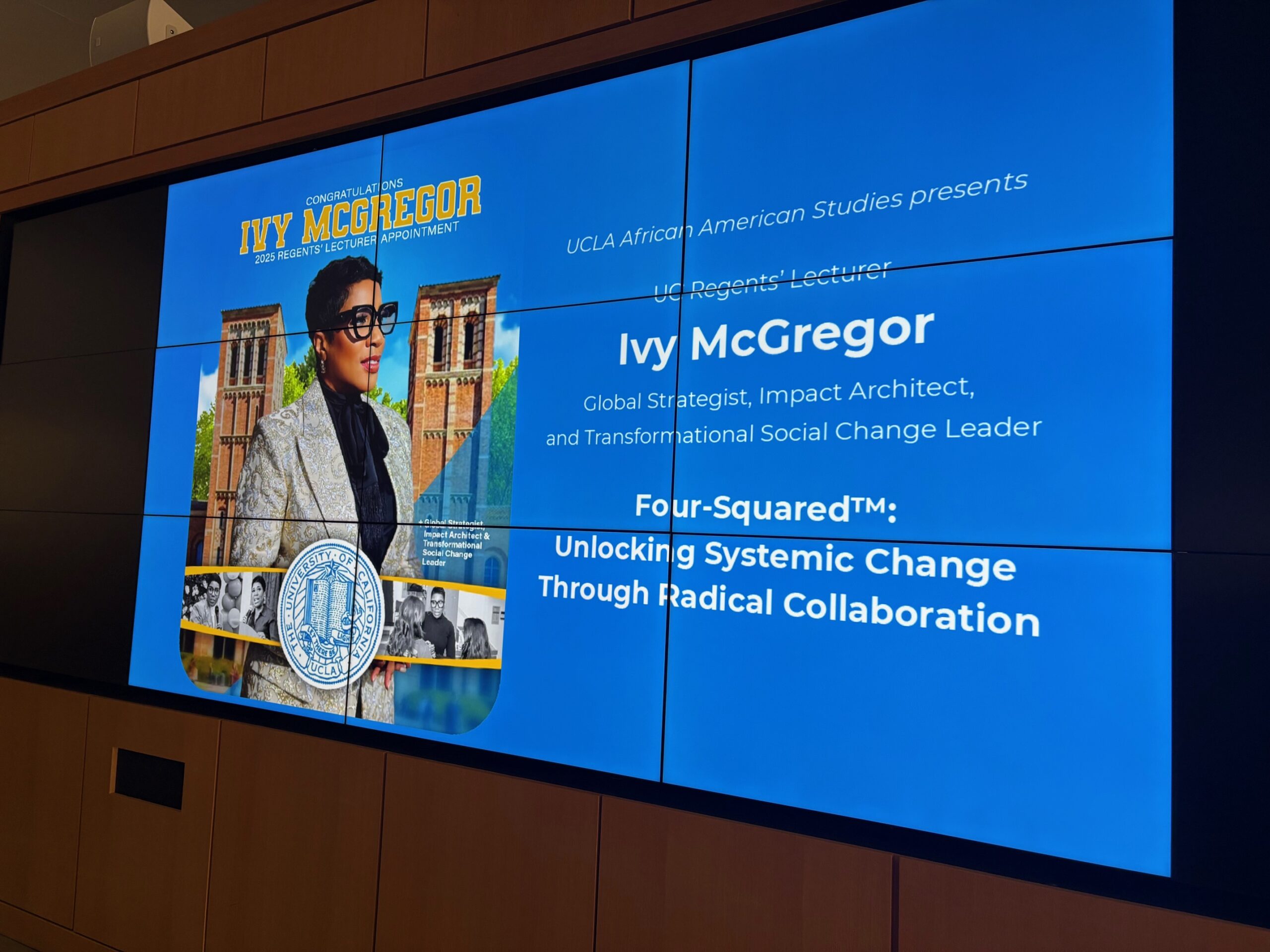
When Ivy McGregor took the stage for her UC Regents’ Lecture she delivered an urgent message. McGregor said that the most pressing social challenges facing society today will not be addressed if we continue to work in silos. Change, she said, will require radical collaboration.
In an evocative address held at UCLA’s California NanoSystems Institute (CNSI) on Oct. 8, McGregor, a global strategist, impact architect and transformational changemaker opened her lecture by telling students, faculty and community members that oftentimes the biggest transformations we witness in society begin with the efforts and intention of a single individual, reminding audience members of their own power to advance a new framework for enacting change.
As an example of this truth, she referenced her mother, 87, who was in attendance. Raising five children on her own, she instilled the blueprint for social action from which McGregor continues to draw inspiration for the work she does today.
“She made sure there was always an abundance of integrity, of love, of prayer, of compassion, and, of course, hope. And what we lacked in money, we made up for in connection, in community,” said McGregor.
Marcus Anthony Hunter, the Scott Waugh Endowed Chair in the Social Sciences Division and professor of sociology and African American Studies at UCLA, introduced McGregor at the event. His idea to nominate her for the Regents’ lectureship was borne out of witnessing the profound impact she had on his students during a guest visit to his “African American Studies M5: Social Organization of Black Communities,” class last fall.
“Oftentimes, in a class, the students say, ‘All this talking is great, but I want to meet application. I want to meet somebody in the world of work, and I want to be inspired by them,’” said Hunter.
He recalled how his students were so energized by McGregor’s visit, they stayed an hour past the scheduled end time to engage with her.
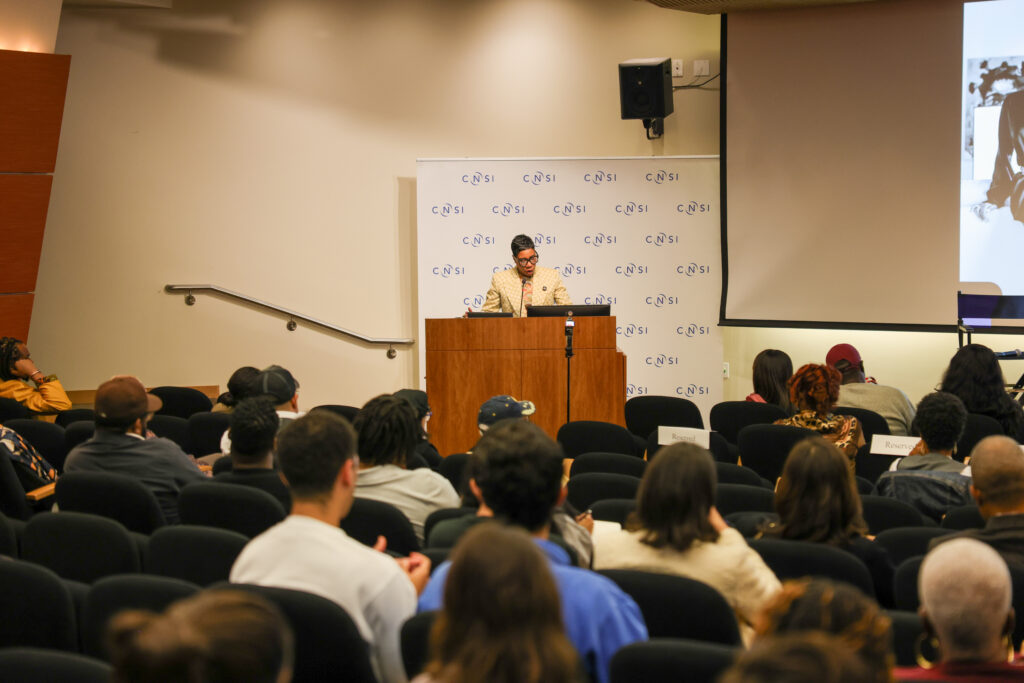
Photo: Adrian Davis
McGregor’s talk, titled, “Four-squared™: Unlocking Systemic Change Through Radical Collaboration,” was grounded in the vast social disparities facing the world today. McGregor discussed how 1% of the world’s population controls nearly half of its wealth; how 700 million people still live in extreme poverty; and how by the year 2030, 375 million workers will need re-skilling to remain employed.
“These are not just statistics,” she declared. “These are signals, signals that we cannot solve 21st-century problems with 20th-century systems.”
Drawing on her decades of experience leading initiatives across the nonprofit, corporate, philanthropic and entrepreneurial sectors, McGregor then introduced her “Four-Square™” framework, a model that connects these forces to drive systemic impact.
“I’ve seen each of these pillars move mountains,” McGregor said. “But I’ve also seen their brilliance trapped in silos, and I came to believe something radical, and it is that the future will not be built by one sector alone. It will be built at the intersections.”
“When these forces converge, collaboration becomes currency,” she continued.
For over a decade, McGregor served as executive director of BeyGOOD Foundation, the public charity founded by Beyoncé Knowles-Carter, where she advanced initiatives in economic equity, education, disaster relief and small business development. Known for her human-centered and hands-on approach, she has designed and led programs that address health disparities, HIV/AIDS prevention and anti-human trafficking efforts, while also advising world leaders, corporations, grassroots organizations and the United Nations.
At UCLA, McGregor urged audience members to look beyond the continuum of their social networks and to “reach across the table, across the aisle and across campus.” She invited audience members to embrace one of her signature concepts, “issue escape rooms,” intentional silo-breaking spaces that foster cross-sector dialogue and collaboration. She said, this concept could be adapted as an “issue escape tables” and easily put into practice over a meal.
“I invite you to create an ‘escape table’,” she said. “I invite you to make sure that there are individuals at your table that represent diverse sectors. So, bring someone to the table that represents wealth, bring someone to the table that represents innovation, bring someone to the table that represents need, and create an issue and say: ‘I know that the 4-5-6 of us can create a solution.’”
McGregor concluded her lecture by reminding audience members that they each have a role to play within her Four-Square™ framework as innovators, investors and amplifiers.
“This is a clarion call, my sisters and brothers, because the future doesn’t belong to the powerful. It belongs to the partners, and it begins here at UCLA, where ideas don’t just live in lecture halls, where ideas become movements.”
McGregor’s address marked the beginning of a visiting residency at UCLA during which she will attend other convenings and conversations with faculty and students designed to catalyze cross-disciplinary collaboration.
Executive Vice Chancellor and Provost Darnell Hunt and Chair of UCLA’s African American Studies Department Cheryl Keyes also provided welcoming remarks at the event. The event was hosted by UCLA’s Department of African American Studies and co-sponsored by UCLA’s Initiative to Study Hate, UCLA’s Dialogue Across Difference Initiative, UCLA’s Department of Sociology, UCLA’s Ralph J. Bunche Center for African American Studies and UCLA’s Division of Social Science.
The Regents of the University of California established the Regents’ Professors and Lecturers Program to allow the appointment, on a visiting basis, of distinguished leaders to increase students’ exposure to a diverse range of successful professionals, artists and others. Vice President Al Gore, actor Anthony Hopkins, Grammy Award winner Quincy Jones, filmmaker Kassi Lemons, jazz and blues pianist Henry Butler, composer Arturo Márquez and, activist-scholar Angela Davis, are among those who have delivered past lectures.
Corazon Adamo, a first-year physiological sciences major who attended McGregor’s lecture with Hunter’s current class, said she walked away feeling inspired.
“It all starts with finding ways to connect with those who might think differently from you, because they can open your eyes to new ways and can help fulfill your purpose and change your community.”
UCLA study shows systemic inequalities and redlining practices contributed to fire vulnerability and impacts

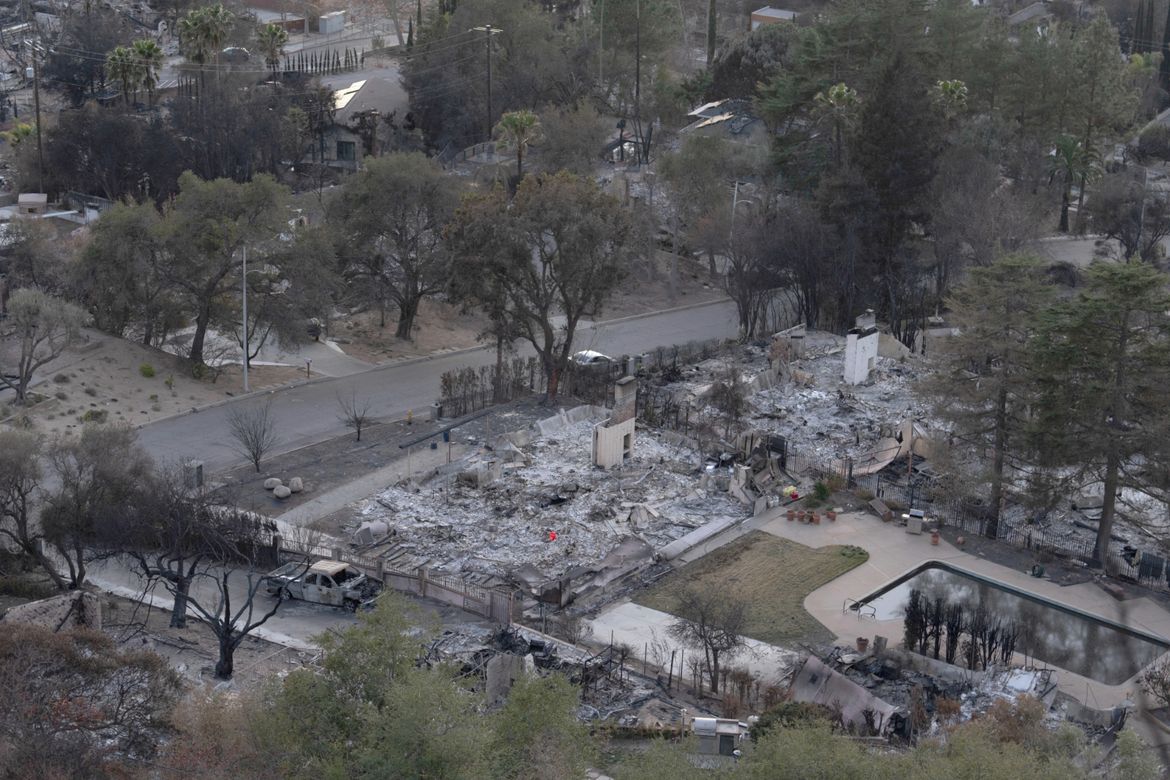
The 2025 aftermath of the Eaton Fire in Altadena. / Photo Courtesy: Mayra Beltran, Los Angeles County
Kacey Bonner
The Eaton Fire has had devastating and disproportionate impacts on Altadena’s Black community, according to a new data brief from the UCLA Ralph J. Bunche Center for African American Studies, the UCLA Center for Neighborhood Knowledge and the UCLA Latino Policy and Politics Institute.
“Altadena’s Black community has long served as a symbol of resilience and opportunity in the Los Angeles region, but the Eaton Fire exposes how decades of segregation and the legacy of redlining practices have left Black households more vulnerable,” said Lorrie Frasure, a professor of political science and African American studies who directs the Bunche Center. “The recovery process must acknowledge this historic legacy and the disparities stemming from it to provide tailored support that ensures the restoration and future of this vibrant community.”
According to the report, at least 2,800 Black households were forced to evacuate within a day of the Eaton Fire’s outbreak on Jan. 7, 2025. As flames ravaged the area, a disproportionate number of homes damaged or destroyed were concentrated in neighborhoods historically occupied by Black residents. Now, the middle-class enclave not only faces the challenge of rebuilding and restoring residents’ homes, but also the long-term challenges stemming from systemic inequities to sustain and grow this historic Black community.
The study highlights several key findings:
The data brief notes that Black residents impacted by the Eaton fire, which burned more than 14,000 acres, will face unique challenges that require tailored solutions to address systemic inequities exacerbated by this crisis.
“The Eaton Fire has the potential to accelerate the decline of Altadena’s Black community, erasing generations of progress,” Frasure said. “Policymakers and relief organizations must act swiftly to protect the legacy and future of this historic community.”
“It is critical to place the consequences of the Eaton Fire in a broader historical and societal context,” said Paul Ong, research professor and director of the UCLA Center for Neighborhood Knowledge. “Doing so highlights the numerous challenges and inequalities African Americans face in the United States today.”
The authors stress that Altadena, a hub of Black homeownership and cultural vibrancy, now faces an uncertain future. They point to their findings as a stark reminder of the systemic inequities that persist, at least in part, due to the legacy of discriminatory housing policies. Their report calls for disaster recovery strategies that are equitable – prioritizing not only immediate restoration but also the sustainability of historic communities, which remain among the most vulnerable to disasters.
This story was originally published in the UCLA Newsroom on January 28, 2025
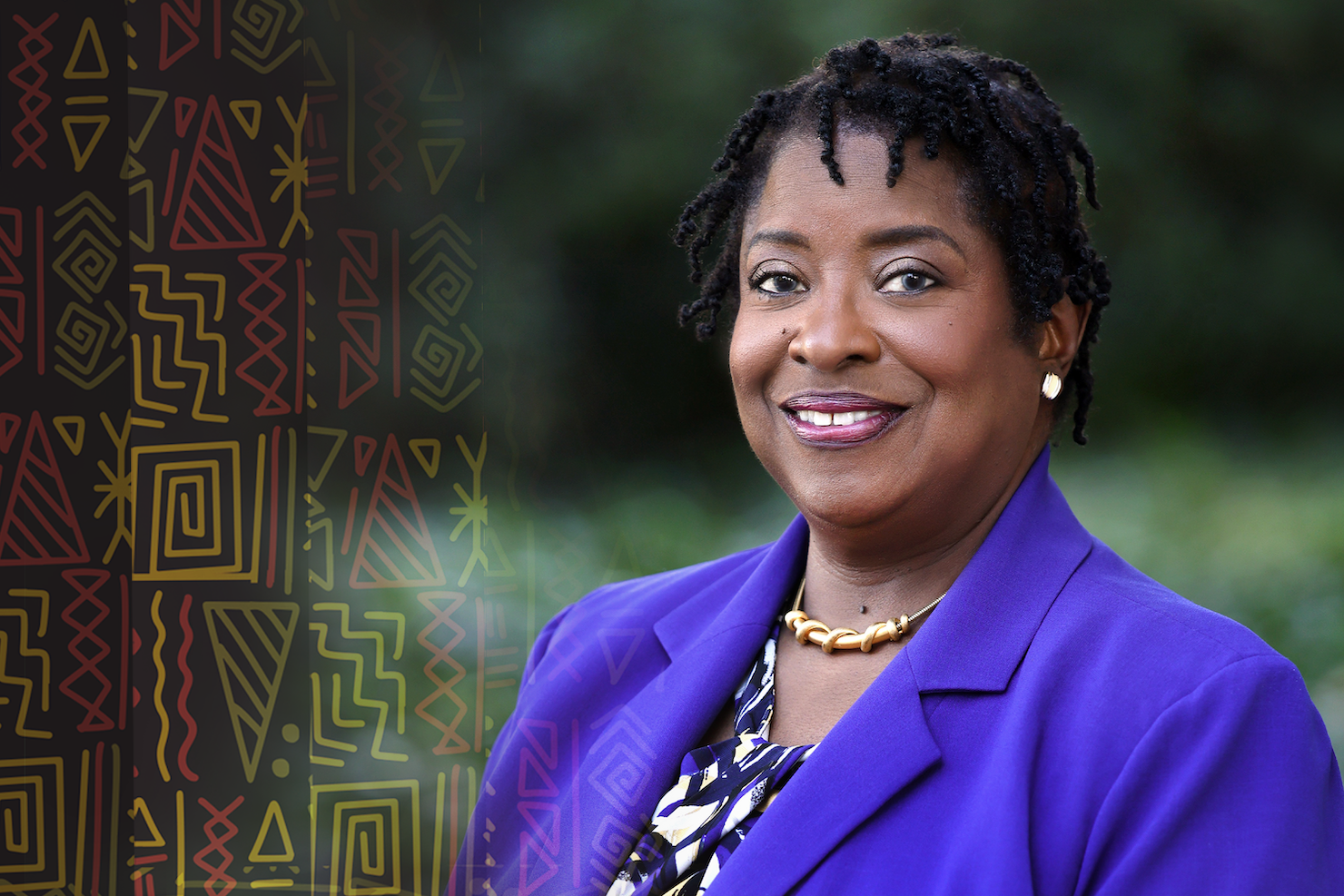
Professor Cheryl Keyes invites all to join UCLA’s campus prelude celebration on June 5
By Jonathan Riggs
For Cheryl Keyes, the celebration has been a long time coming.
Ever since Juneteenth (June 19) became the newest federal holiday in 2021, Keyes, chair of the UCLA Department of African American Studies, has been carefully planning how she could best commemorate it on a big Bruin scale.
Everyone is invited to see how her hard work and dedication will pay off June 5 at Royce Hall with UCLA’s inaugural Prelude to Juneteenth Day Celebration: Honoring Our Past, Celebrating Our Future, a free multimedia event that incorporates a variety of creative, academic and inspiring voices.
“I want to celebrate Black life with a lineup of artists and educators whose work will titillate the soul and reflect the incredible interdisciplinary scholarship of our department,” said Keyes, who produced the event. “We took the time and put the passion into making this program something that celebrates inclusive excellence, community engagement and the rich history of the Black experience.”
During the long and thoughtful planning process, the event’s shape began to crystallize after Keyes had a serendipitous conversation with Earl Stewart, an acclaimed composer and associate professor emeritus at UC Santa Barbara. Inspired by her vision, he revealed that he had a very special connection to the holiday.
During his last year of graduate school, Stewart became interested in Juneteenth when his colleague Melvin Wade shared his research on an article about the actual activities that took place on the day. He also discovered that Wade’s mentor was one of the top Black Texas legislators who successfully led the push for Juneteenth to become a state holiday in 1980. Having learned about its true meaning, Stewart decided that Juneteenth should be commemorated by a symphony.
“While working on the composition, I began to see Juneteenth as something more than just a celebration of the freedom of Black people from slavery. To me, Juneteenth also symbolized the political birth of the African American race,” Stewart said. “Although African Americans gave themselves specific names before their liberation, we were not officially recognized as a specific people in America until after the Emancipation Proclamation. It is a complete honor for me to participate in this UCLA celebration and premiere my Juneteenth symphony.”
Another aspect that Keyes wanted to illuminate in the celebration is the idea that Black history did not begin with American enslavement, but with great empires in Africa. And so Keyes, who is also a professor of ethnomusicology and global jazz studies, composed her own piece for orchestra, “Sundiata Keita Overture,” named in honor of the royal founder of the Mali Empire. Like Stewart’s “Symphony #4: Juneteenth,” it will receive its world premiere at the event.
The event’s lineup of artists also includes actor Abdoulaye N’Gom, emcee James Janisse, freestyle lyricist Medusa the Gangsta Goddess and guest conductor Antoine T. Clark, among other luminaries.
“To participate in this particular celebration and return to the community that nurtured me as a scholar, an artist and an engaged citizen is an honor and a privilege,” said choreographer/dancer Bernard Brown, who earned an MFA from UCLA in 2017. “Supporting the arts supports the best of humanity. Come and be moved by the beauty and truth of Black music and dance!”
“I’m hoping that my musical performance is received as the sum of my own personal ancestry in America,” said violinist Karen Briggs, who is also known as the “Lady in Red.” “Fundamentally, I see myself as a sum of those that came before me and in a way that could have only come authentically from the legacy of the African American spirit. I am proud to be able to present this aspect of my culture through the voice of the violin.”
The event is likely to be as educational as it is emotionally moving, whether attendees are already knowledgeable about the history and meaning of Juneteenth or are learning about it for the first time.
“UCLA is fortunate to have such a remarkable department, led with such creativity, wisdom and compassion. It is no surprise that professor and department chair Cheryl Keyes has set and achieved her vision of creating an event as powerful, uplifting and resonant as this important occasion deserves,” said Abel Valenzuela, dean of the UCLA Division of Social Sciences. “I encourage everyone to attend this important celebration and to carry its message of history, hope and healing forward.”
This article, written by Jonathan Riggs, originally appeared in the UCLA Newsroom.