U.S. Fertility Rates Drop to Another Record Low



The UCLA study quantifies the benefits of federal programs that fund contraception for low-income Americans

Citlalli Chávez-Nava
A UCLA clinical trial finds that reducing the costs of contraception results in 16% fewer unintended pregnancies and 12% fewer abortions among low-income women after two years.
In a working paper published by the National Bureau of Economic Research (NBER), the study offers rigorous experimental evidence that directly connects financial access to contraception for a broad population of women in the United States, helping to answer questions of long-standing academic and policy interest.
“According to our findings, eliminating financial barriers allowed women to choose more effective contraception methods and reduce undesired pregnancies and abortions,” said Martha Bailey, professor of economics and director of the California Center for Population Research, and the study’s lead author.
In the U.S., the rate of unintended pregnancy is more than five times higher among women in poverty than women with incomes at least two times the poverty level. The study suggests that the high cost of reliable contraception is an important contributor.
The findings are particularly relevant for policy discussions surrounding ongoing cuts to the Title X program, which serves millions of low-income Americans.
Removing all contraceptive costs through M-CARES study
The findings were based on the Michigan Contraceptive Access, Research, and Evaluation Study (M-CARES) which recruited low-income women at Title X medical providers between 2018-2023. During this period, randomly assigned participants were given vouchers that made any method of contraception free or sharply discounted. The goal of the M-CARES study was to remove cost barriers for all methods available at Title X providers and to follow changes in the choice of contraception and pregnancy outcomes over time.
The findings were based on the Michigan Contraceptive Access, Research, and Evaluation Study (M-CARES) which recruited low-income women who sought care through Title X, a federal program that subsidizes reproductive health and family planning services for low-income Americans, between 2018 and 2023. During this period, randomly assigned participants were given vouchers that made any method of contraception free or sharply discounted. The goal of the M-CARES study was to remove cost barriers for all methods available at Title X providers and to follow changes in the choice of contraception and pregnancy outcomes over time.
Based on data analysis over a two-year period, the study found:
“It’s important to note that the effects of the study last well beyond the availability of the subsidies. The effects of increasing affordability extend over a two-year period and likely beyond,” said Bailey.
Furthermore, unlike previous academic studies, the M-CARES survey findings include high-quality administrative micro-data offering a more comprehensive view of contraceptive use.
“Most studies have only been able to document changes in childbirth. Because we had administrative records, we were able to see changes in pregnancies and abortions, which are severely underreported in surveys,” added Bailey.
Timely findings for the 2026 Congressional budget adoption
In March of this year, the Trump Administration announced a freeze of close to $35 million in funding to Title X grantees. This freeze left California, among seven other states, without Title X funding. And there is a strong possibility this program will continue to face cuts or complete elimination for the upcoming 2026 federal fiscal year.
Bailey thinks that further disruptions to Title X grantees will be devastating for low-income women, worsening not just their health, but their social and economic outcomes as well as resources for their children.
“Generalizing our survey findings, we see that keeping Title X sliding scale costs as they stand now, results in significantly higher rates of unintended pregnancy among low-income women and causes more abortions nationally than if contraception were completely free,” said Bailey.
Instead, Bailey says the M-CARES evaluation provides evidence that federal Title X dollars help U.S. families and expanding the program would also have benefits.
“The Title X program is a cost-effective way to empower parents to choose their families according to their own desires,” she said. “Preserving Title X and expanding its generosity would strengthen the reproductive health safety net.”


Martha Bailey is breathing history into data. The UCLA economic historian, demographer and labor economist is stitching together the rich tapestry of American life across four generations through her visionary leadership of LIFE‑M, a unique data infrastructure project linking millions of birth, marriage and death records with census information on everything from household size and wages to educational attainment.
The goal? To help researchers across the country better ask and answer big questions about how economic, educational, health-related and environmental circumstances and policies have shaped people’s lives from the cradle to the grave since the dawn of the 20th century.
“The biggest changes in our society and economy don’t play out over a decade,” says Bailey, who also directs the California Center or Population Research at UCLA and is a research associate at the National Bureau of Economic Research. “They play out over multiple generations as part of ongoing, slow-moving transformations.”
That’s why the datasets of LIFE-M (short for Longitudinal, Intergenerational Family Electronic Micro-database) are so revolutionary. With the help of machine learning, the project compiles reams of intergenerational public information that present a grand survey of life changes — from great-grandparents born at the turn of the century to their grandchildren born in the 1970s.
For instance, Bailey says, LIFE-M data clearly reveal how government investment in education has boosted economic opportunity — from the early 20th century, when public funding of K–12 schools allowed lower-income children to escape the circumstances of their birth, to the later years of the century, when investment in public higher education further encouraged mobility, reducing the role of family privilege.

Similarly, by compiling data over multiple generations in a particular community, the project offers an expansive picture of people’s quality of health and aging. This can be particularly helpful, Bailey says, when scholars are assessing how environmental exposures may contribute to cognitive conditions like Alzheimer’s and Parkinson’s over time or when they’re tracking the evolution of a cancer cluster in a newly industrialized area.
“Like roads and bridges,” she says, “data infrastructure is foundational for answering fundamental questions about health and social policy.”
LIFE-M, which has been used by hundreds of social scientists, took a decade to set up and was seeded with National Science Foundation funding. Yet just as the project planned to expand its dataset from two states to nine with the help of a National Institute on Aging grant, that funding was frozen. Important research projects have been put on hold, Bailey notes, but it’s the state’s larger educational enterprise that is really in peril.
“The funding and expertise of our researchers spills over into a top-notch education for students, who go onto all types of professions. It’s one big package; research and teaching are deeply interrelated. Losing funds leads to losing the best faculty and best graduate students to other universities and countries, which is a huge loss for California’s public higher education.”
This post was originally published via https://www.ucla.edu/research.
—
Learn more about Martha Bailey’s visionary LIFE-M project at UCLA.

Participants in social safety net programs had higher rates of employment, were less reliant on public assistance

Citlalli Chávez-Nava
As federal social safety net programs face elimination or budgetary reductions under the new administration, a UCLA report has found some of the boldest War on Poverty programs launched in the 1960s and 1970s reduced poverty and improved upward mobility and well-being.
Launched in 1964 by President Lyndon Johnson’s administration, the War on Poverty represented one of the largest and most comprehensive attempts to improve well-being in United States history. The administration invested billions of dollars in education, health, employment and community development initiatives — including Head Start, an expanded food stamp program, family planning programs and community health centers. The campaign targeted the roots of poverty, seeking to provide a “hand up, not a handout.”
The study, recently published by the National Bureau of Economic Research, looks at how access to these programs for children in the 1960s and 1970s shaped the outcomes and living circumstances of tens of millions of adults today, using newly available large-scale data from the U.S. Census Bureau and the Social Security Administration. The decades-long research was led by Martha Bailey, professor of economics and director of the California Center for Population Research at UCLA.
Head Start, which aimed to reduce poverty and still serves 1 million children today, offers early education to preschool and kindergarten-aged children, nutritious meals and referrals to health and other social services. But for decades, evaluating the program’s success in helping children escape poverty was difficult since researchers faced data challenges in identifying valid comparison groups.
Using the newly available data, researchers measured Head Start’s success in terms of children’s later-life educational attainment, work in professional occupations, participation in the labor force and wage earnings. Researchers compared children who were born a few months too soon to enroll during Head Start’s initial rollout with children who did enroll. Head Start children were significantly more likely to finish high school and enroll in and finish college than peers who entered first grade without access to the program (Figure 1). The results also show that cohorts with access to Head Start experienced lower rates of adult poverty, had higher rates of employment and were less likely to have received public assistance.
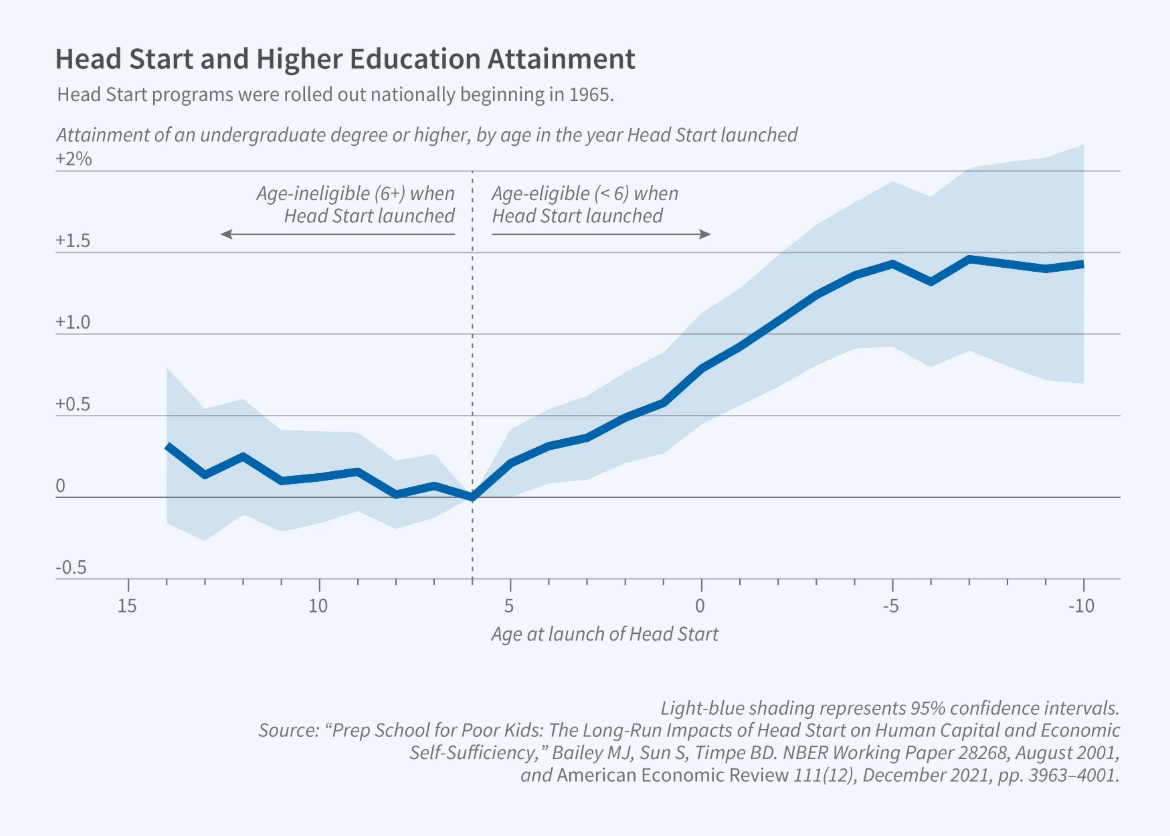
“It’s important to consider the long-run consequences of public programs,” Bailey said. “Investing in children is like planting a seed. Many of the programs starting in the 1960s are still having measurable effects today.”
Based on analyses of hundreds of on-the-ground programs across the U.S., the report also found:
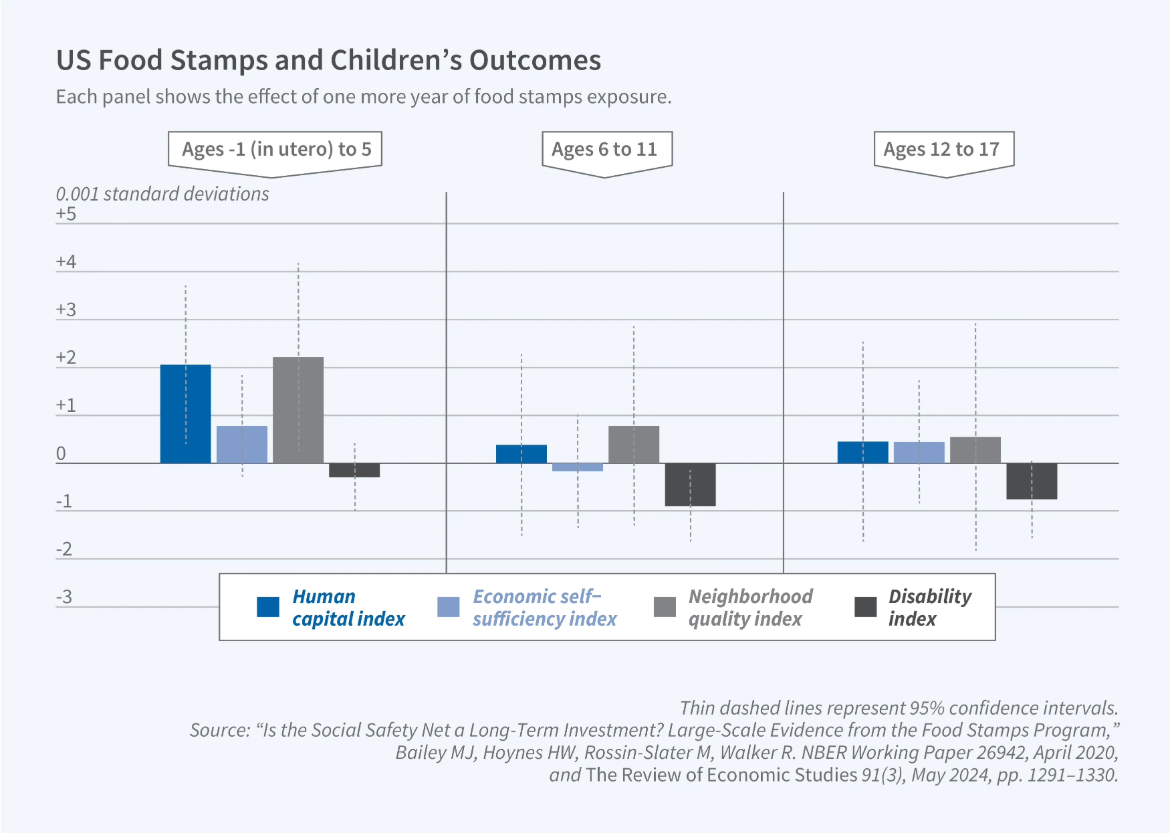
“The data show that U.S. poverty rates, health, human capital and employment outcomes would have been worse today without the substantial investments made under the War on Poverty,” Bailey said. “In many cases, the benefits of the programs well exceeded their costs.”
This story was originally published in UCLA’s Newsroom, here.