
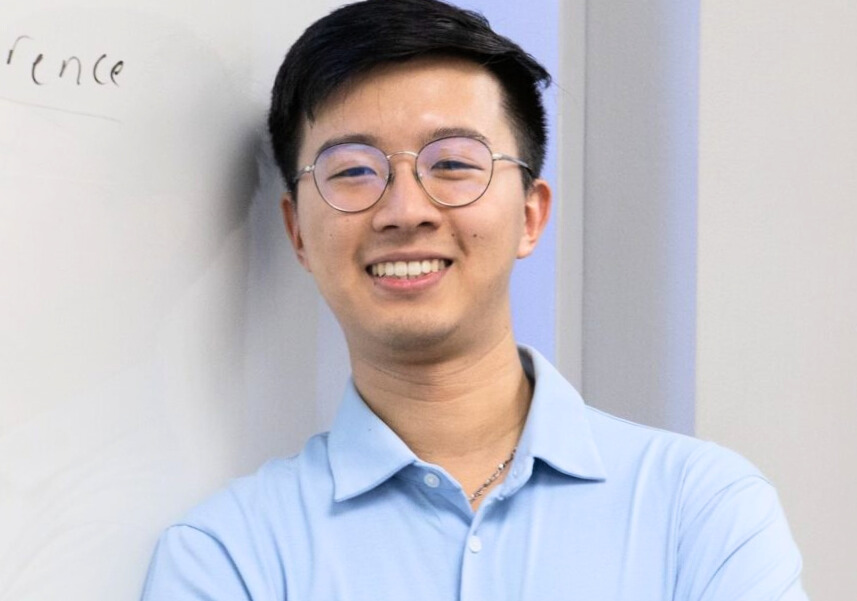
Interview featuring James Lee, fifth-year economics student, who will teach a research course through UCLA’s Collegium of University Teaching Fellows Program exploring this topic
Citlalli Chávez-Nava
Is going to college still worth it? What can government policy do to improve educational outcomes? And how do researchers measure the real return on education?
Those are the kinds of questions that James Lee, a fifth-year doctoral candidate in UCLA’s Department of Economics, will explore in his undergraduate students in his course, “Research Practice 98T: Economics of Education.”
Lee was selected as a teaching fellow in UCLA’s Collegium of University Teaching Fellows (CUTF) program, a campuswide initiative coordinated by UCLA’s Learning and Teaching Center that brings together a group of innovative graduate student instructors. Fellows design and teach one-time undergraduate courses that connect cutting-edge research and creative practice.
CUTF courses, offered each winter and spring, also give undergraduates an opportunity to engage directly with faculty-level research while learning what graduate study entails.
Lee’s course is designed for students interested in education policy and economic research. The class will examine economics research spanning the full arc of education —from preschool to college — exploring both theory and real-world outcomes. Along the way, students will gain hands-on empirical research skills. They will learn to code in R, a free, open-source programming language used for data analysis and visualization, work with public microdata and write a literature review. By the end of the quarter, students will submit a peer-reviewed policy proposal aimed at increasing educational attainment.
In the interview below, we learn more about Lee’s upcoming class, how he became interested in economics and education policy and his future plans.
The interview was edited for length and clarity.
How did you become interested in researching education policy and its economic impacts?
I’ve always enjoyed teaching students, so I think when I was searching for a research topic I was naturally drawn to education. I specifically research community college and transfer students. Interestingly, this focus began through a random conversation I had with a transfer student here at UCLA about the Transfer Admission Guarantee Program known as TAG. I had never heard of a guaranteed admission program, so that led me to look further into the university and community college systems and student choices and outcomes.
You say your class will explore the full arc of education beginning in preschool. Does preschool lead to specific to educational outcomes?
There is quite a bit of research and experiments done for young children and early education. For example, pre-K and universal pre-K programs have been found in several papers to have very high economic returns — parental income increased due to parents having more time to work and children’s non-cognitive skills increased from going to preschool. The “Heckman Curve,” developed by economist James Heckman, illustrates that investments in early childhood education have the highest returns to society, and that the returns decline with age.
Plus, I think it would be a more complete class if we went through the whole range of education – from preschool to college.
What are some of the other topics you’ll explore during lectures?
The class will start with some basic economic theory, technical skills and definitions to catch everyone up to the same level. Then we will learn about different economic theories about education before going through research related to different education levels, like preschool, elementary, middle, high school and college. We’ll discuss different policies, such as universal pre-K, academic tracking in schools and whether college should be tuition free.
As college students, I’m sure students will also be curious about discussing things like whether the friends you make or the major you study or your professors impact long-term outcomes like earnings.
I’ve also learned a lot from talking to all sorts of students at UCLA since everyone has their own unique experience, so I also hope every student feels empowered to share their own experiences in my class.
Your class concludes with a policy proposal. Why do you think it’s important to include an assignment of this type?
I wanted to include a final assignment that could demonstrate what the students have learned throughout the class while also putting together a document that could serve as a writing sample for their future endeavors. I also think it’s important to be able to put together an organized document that can be used to pitch an idea to a broad audience and provide logical explanations in a succinct manner.
…
What led you to pursue your doctorate in economics at UCLA?
Honestly, I had never touched economics before college, but once I entered college, I thought I’d give it a try. I really enjoyed it because it’s a quantitative social science. I was drawn to social science research in undergrad but wasn’t sure about academia, so after graduating I worked as a research associate at the Federal Reserve Bank for two years before I decided I wanted to pursue a Ph.D. Ultimately, I wanted to do research about people and policy that could make things practically better, so an economics Ph.D. seemed to be the right fit.
What is your dissertation topic?
In recent years, more schools and states are encouraging more community college students to transfer. Given this push, a question that has come up is what might happen to the students already present at a receiving institution.
My dissertation takes a first step in answering this question by investigating the peer effects between community college transfer students and freshman admits at UCLA. I find that, on paper, academic outcomes improved for freshman admits by having more transfer students in their classes, but I find evidence that there is no actual ‘gain’ in knowledge. While my interview and survey-based findings would suggest that there could be beneficial effects from these two groups interacting, it appears that these groups do not interact much in the classroom. If anything, the only interaction is due to the “curve” present in certain classes and departments.
Despite this, I find no evidence of harmful effects on initial post-grad outcomes and given the on-paper benefit for academic outcomes and the massive benefit for transfer students to be able to transfer to a school like UCLA, I conclude that having transfer programs does not hurt the students already present at a given university.
I hear you just landed a job, where are you going next?
I’ll be an assistant professor in the economics department at Pepperdine University next year.
Do you feel the CUTF program has helped you grow as an instructor?
I think the CUTF program has been great to learn about properly organizing a class, such as developing the syllabus, preparing lesson plans and learning ways to engage students.
It’s also been great to be with other fellows who are also designing a class for the first time in other fields. I’ve also learned about other resources that I admittedly hadn’t really considered before — I’m very excited to use my new knowledge and skills once I start my class next quarter.
…
Lastly, is college still worth it? What would you say to those who are skeptical about the value?
I’d say it’s still worth it, but there’s a pretty big asterisk about that statement. From a data perspective, the benefits still outweigh the costs on average. Though, college is what you make of it – such as what you choose to study, who you become friends with, how you spend your time both inside and outside the classroom and what opportunities you find.
Most students would say what they learn in class feels unapplicable to their future job. Depending on your field or job, that could very well be true. But one economic theory of education says that a college degree is a signal that you are smart and capable enough to make it through the challenging environment that is college. From that point of view, if you know how to market yourself well, you could achieve high returns no matter what you studied.
Another economic perspective tells us college is a time to invest in yourself – your human capital. That’s both your cognitive skills as well as your non-cognitive skills. But again, it’s what you personally make of your time in college.
Lee’s 2026 spring quarter class is listed as: “Research Practice 98T: Economics of Education, SEM 1 (Lee) – Tuesday/Thursday 10-11:50am.” A listing of all CUTF courses is available: here.