
Supported by the W.M. Keck Foundation, the project combines field research and artificial intelligence to understand how trees transport water and withstand drought
Citlalli Chávez-Nava
More than 200 years ago, Alexander von Humboldt, the German geographer and naturalist whose explorations of Latin America helped establish modern physical geography, began describing how deforestation might be altering rainfall patterns around Venezuela’s Lake Valencia.
Well ahead of his time, Humboldt recognized that forests could play an important role in regulating climate and water availability. His prescient observations helped inspire a question that geographers continue to analyze two centuries later, explains UCLA geographer Yue Li.
“His question is a classic question in geography. To this day, we continue to analyze and quantify the effects of deforestation on climate; it forms part of the teaching materials I explore with students in my department,” Li said. “But now we have more powerful AI tools that combine massive amounts of observations with the physics of Earth system models to better predict the future.”
Today, Li is using these modern innovations to revisit Humboldt’s observations at a much finer scale: he’s investigating the intricate internal tree plumbing system — known in his field as plant hydraulics — that allows trees to draw water from the soil and transport it to their leaves.
Deciphering this process may hold the answer to some of our most pressing planetary concerns because it could give us clues as to the rainforest’s resilience amid extreme weather events, Li explains.
“The Amazon forest, Earth’s largest rainforest, has endured repeated severe droughts in 2005, 2010, 2015–2016, and 2023. Whether this ecosystem can withstand intensifying drought is one of the most pressing unknowns for planetary safety,” he said.
Through a new project titled: “Do Tree Hydraulics Control Amazon Forest Drought Resilience?” funded by W.M. Keck Foundation, Li and Yiyao Li, his doctoral geography student, are collecting a vast amount of field data as they develop an artificial intelligence model that will allow them to process their data more swiftly than ever.
Building on earlier discoveries to learn about tree resilience
The new research builds on findings from a 2023 study Li published in Nature Water which examined how deforestation and the physiological responses of plants to rising carbon dioxide levels contribute to changing climate conditions in the Amazon.
Using eight Earth system models, Li and his collaborators found that these factors together could explain about 44% of future rainfall decline in the Amazon by the end of the century under a high-emissions scenario.
One important mechanism identified in the 2023 study involved tiny pores on leaves called stomata, which allow trees to absorb carbon dioxide for photosynthesis while releasing water vapor into the atmosphere. Li and his collaborators found that as carbon dioxide concentrations rise in the atmosphere, trees can partially close these pores, reducing the amount of moisture they release.
“The findings underscored the complex relationship between forests and climate, revealing how changes in plant-regulated water fluxes, the processes at which water moves between storage places, under CO2-enriched conditions, can further exacerbate the water stresses that threaten forest health.”
The observations drawn from this study also set the stage for Li’s new Keck-backed study.
“Essentially, we found that plants partially closing their pores is impacting the availability of moisture or rain,” said Li. “Now we’re shifting our attention to the plant hydraulics, a process that is poorly represented in models, across different tree species to figure out the different water strategies they each employ during dry conditions.”
Using AI to understand the rainforest’s plant hydraulics
Although scientists understand the basic principles of plant hydraulics, accurately representing these processes across the Amazon’s vast and diverse ecosystem remains a major challenge.
Trees differ in how efficiently they transport water, how they respond when water becomes scarce and how vulnerable their internal water systems are to failure — but existing observational data is limited.
“Conventional measurements of these traits are sparse, while satellite measurements lack high-quality data due to cloud contamination. Plus, machine learning without constraints is blind to physics and yields uninterpretable ‘black box’ estimates,” Li said.
To overcome these limitations, Li and his collaborators are developing a more comprehensive approach that will bring together ground-based observations, established scientific models and artificial intelligence.
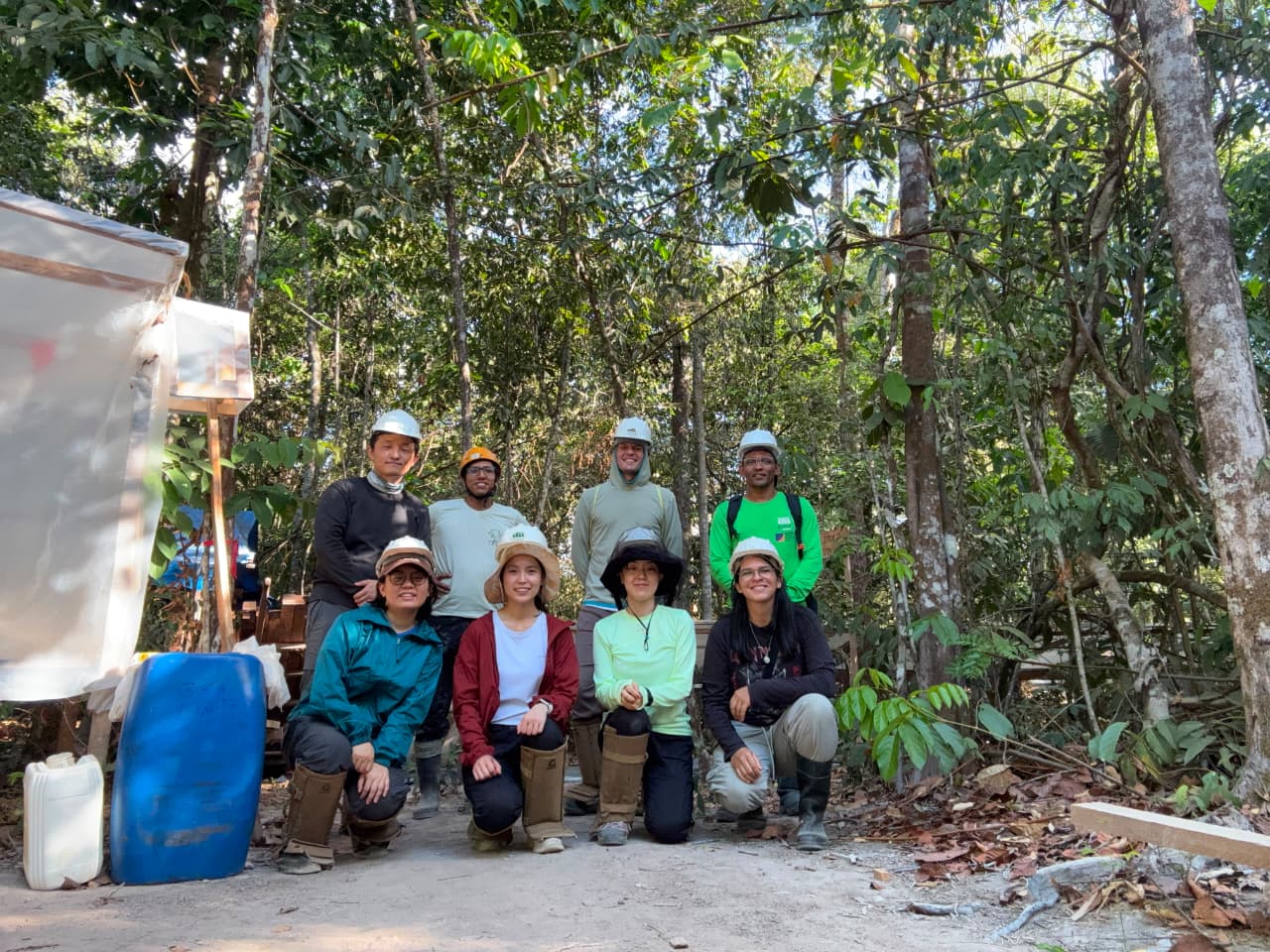
Thanks to the support from the Keck grant, this past summer the research duo traveled to an extremely remote area of the Amazon located in Mato Grosso, a state of central Brazil to begin testing the hard-to-access data and to engage local researchers at the Amazon Environmental Research Institute, a scientific, non-governmental, non–profit organization that works to promote science, education and innovation for an environmentally healthy, economically prosperous and socially fair Amazon and Cerrado.
They plan to work with local field scientists to collect data measuring how forests exchange carbon dioxide and water vapor with the atmosphere and collect sensorial data that tracks water movement through individual trees and satellite imagery to assess the density of leaves in the forest canopy.
“We are collecting real-world data to measure how forests ‘breathe’ — taking in CO₂ and releasing water — and then we are using AI tools and process-based models to find the critical ‘brakes’ that control this process and help keep the Amazon and our planet healthy,” Li said.
For graduate student Yiyao Li, traveling to the Amazon and collaborating with other researchers on site provided an invaluable learning experience only possible through field engagement.
“Being there in person, surrounded by so many different tree species, made me feel a much stronger connection to the forest. It was no longer just a place I study, but a place I genuinely care about,” she said.
“I also experienced firsthand how challenging it can be to collect field data. From purchasing sap flow sensors to testing them in the field, we invested a lot of time and effort. This experience gave me a much deeper appreciation for the work behind the field data we use in the research.”
Professor Li says the grant’s structure provides a framework for a mentor-mentee relationship while giving doctoral students flexibility to explore different research approaches.
“It gives students a stronger sense of ownership and responsibility by engaging them as active contributors to a real research project, rather than simply treating them as student research assistants,” he said.
Improving predictions of the Amazon’s future
Up to now, using existing data and computer-generated climate models, geographers have been able to make some predictions about future global warming and the Amazon’s climate conditions.
But Li says that what makes this moment and this project unique is the fact that his team will be able to process existing data, access vast amounts of new observational data and that the study will consider, specifically, how trees uptake and transport water, to generate a more sophisticated understanding of the plant hydraulic process itself. And then an artificial intelligence model will speed up the data analysis process in unprecedented ways.
“The ultimate goal is to seek an AI model, combined with physics from learning process-based models and constrained by observational data, to predict the future of the Amazon,” Li added.
The research also returns to the fundamental question Humboldt raised more than two centuries ago: how forests and climate shape one another.
But where Humboldt relied on observations of the natural world, Li and his student are combining field measurements, plant physiology, climate science, physics from models and artificial intelligence to investigate the mechanisms behind that relationship.
For Yiyao Li, thinking about how each measurement represents a step toward resolving one of our planet’s most urgent questions is an unmatched endeavor.
“What excites me most about this project is the opportunity to look more closely at what happens within individual trees and connect it to the resilience of the entire Amazon rainforest,” she said.